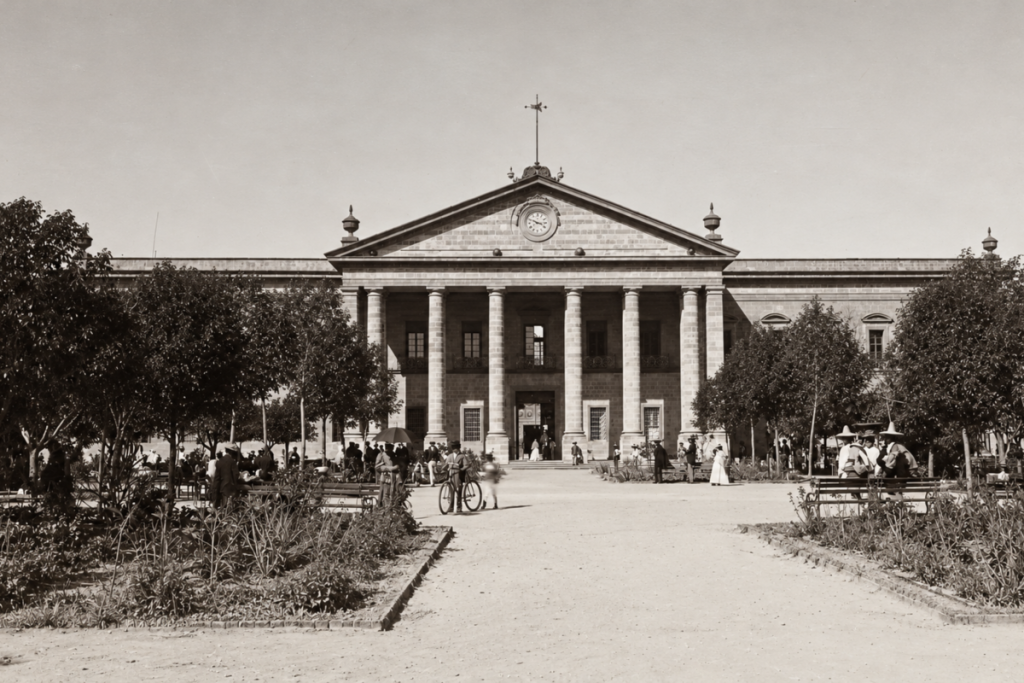

Did you know that where Parque Rojo stands today, there used to be a huge prison that covered about eight city blocks?
It was called the Escobedo Penitentiary and was one of the most imposing buildings in 19th-century Guadalajara.
It had reddish walls, a grand facade, and a public clock, but it was demolished to make way for a new era in the city’s history.
This is what the former Escobedo Penitentiary, or Casa Colorada, looked like
Before becoming one of the busiest spots in downtown Guadalajara, this site was part of the gardens of the Convento del Carmen.
However, in the mid-19th century, the site was set aside for the construction of a penitentiary aimed at modernizing the prison system of the time.
The project eventually spanned about eight city blocks, between what are now Enrique Díaz de León, Puebla, López Cotilla, and Pedro Moreno streets.
Its architecture was neoclassical with reddish walls, which earned it a nickname that is still part of its history: the Casa Colorada.
For decades, the prison operated normally, but the city’s growth eventually swallowed it up.
Why was the prison demolished?
In the early 20th century, Guadalajara began to expand westward, and the old penitentiary found itself caught in the midst of urban transformation plans.
In 1911, the demolition of some parts of the building began, as new roads were opened and the surrounding area changed.
The process continued over the following decades. In 1932, with the inauguration of the new Oblatos Prison, the inmates were transferred to the new facilities.
Finally, in 1933, the last remnants of the Escobedo Penitentiary disappeared.
And so ended the story of a building that had left its mark on the city for nearly nine decades.
From the Prison to Parque Rojo
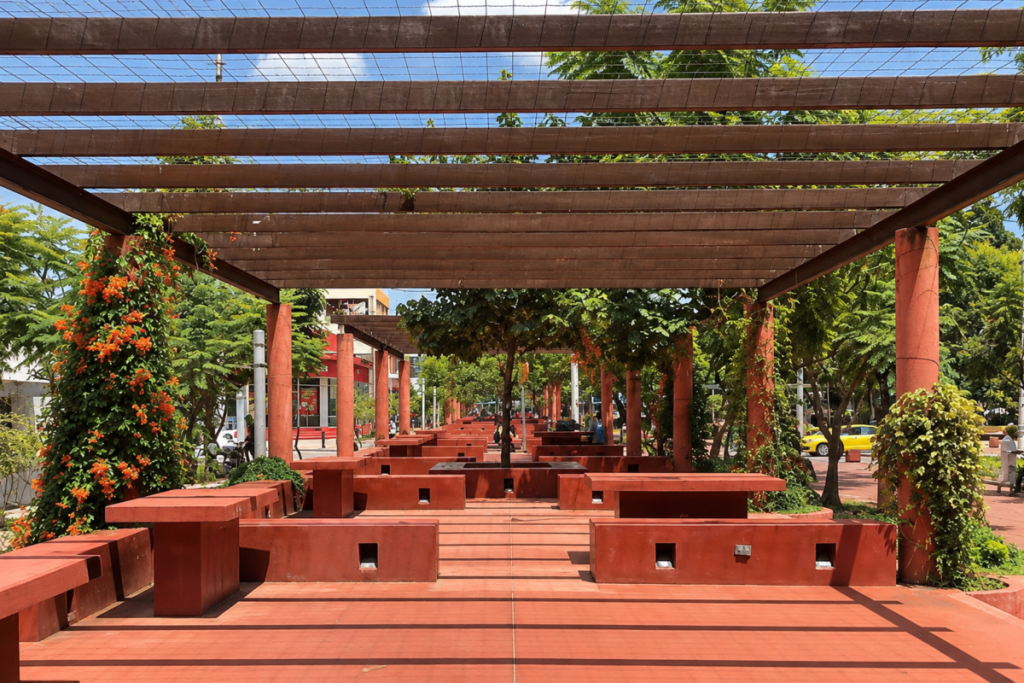
Shortly after its demolition, the site was given a new lease on life. In 1935, Parque de la Revolución—popularly known as Parque Rojo—was inaugurated on the site that had once been occupied by part of the prison complex and its gardens.
The project was led by brothers Juan José and Luis Barragán, and it transformed the area into a public space for social interaction.
Over time, the park became integrated into the dynamic heart of downtown Guadalajara, situated between Juárez and Federalismo avenues, amid shops and public transportation.
Today, it’s hard to imagine that a prison of such dimensions once stood on this very spot.
The next time you pass through Parque Rojo, remember that this everyday space in Guadalajara has a past that few can imagine.